
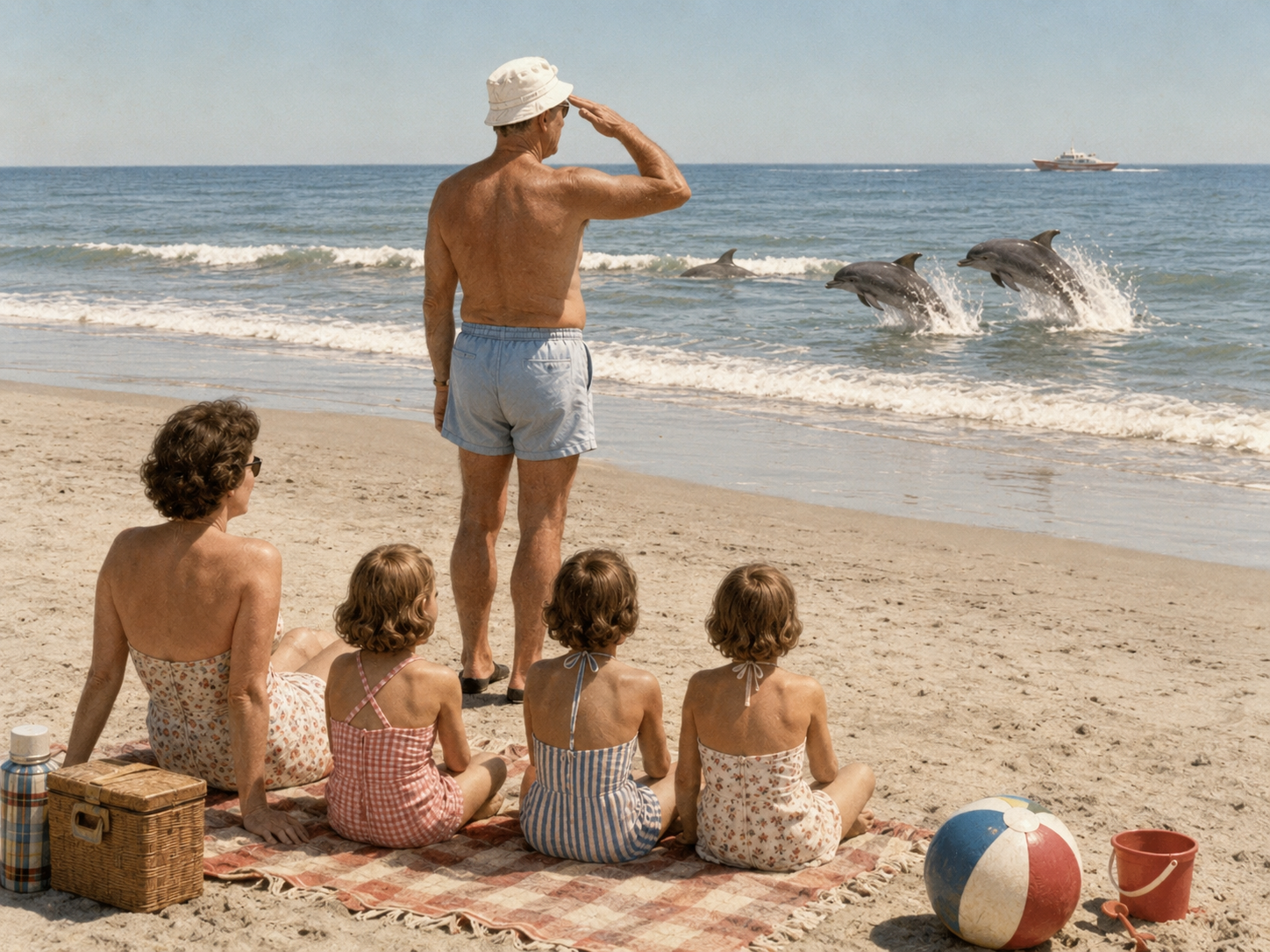
Whenever he stood on the beaches of Wildwood and spotted a pod of porpoises gliding through the surf, his family knew what would come next. . . He would rise, stand at attention, face the ocean, and offer a crisp salute.
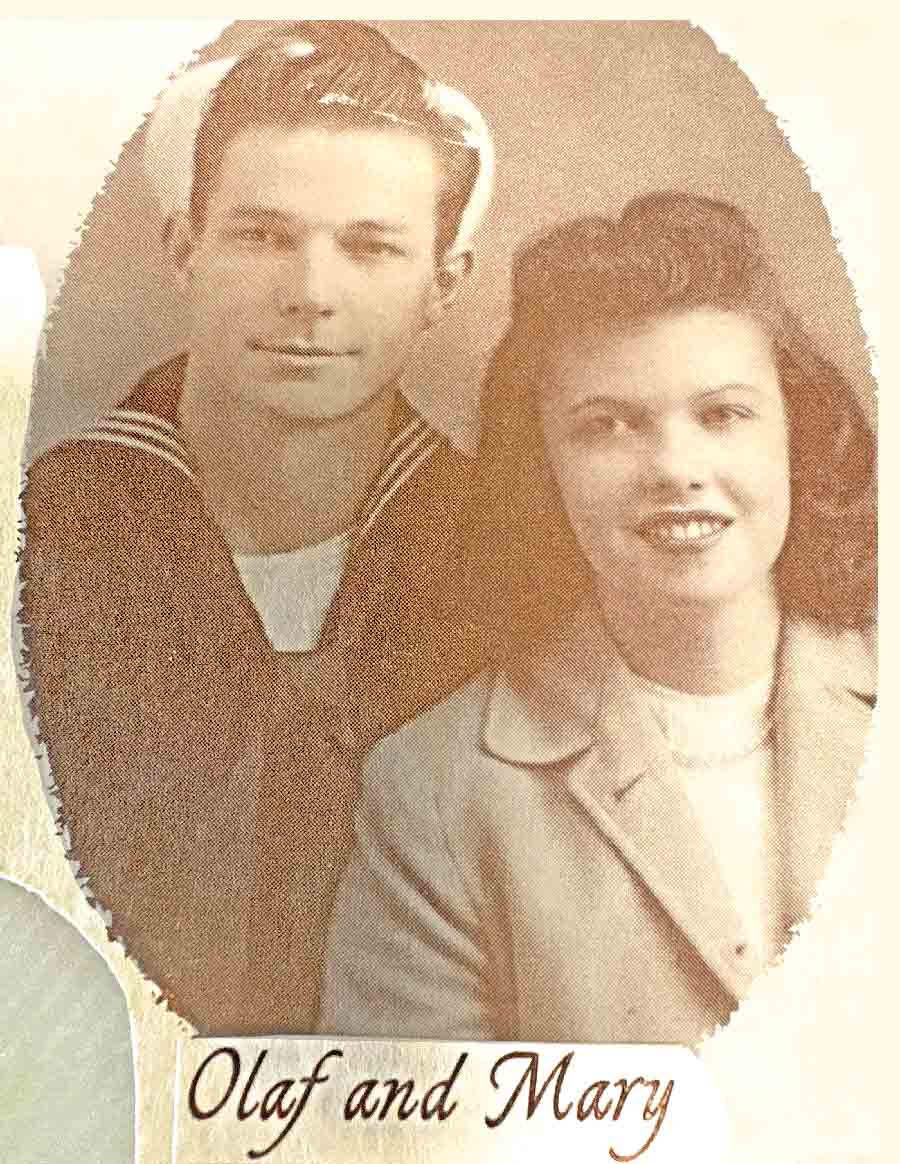
Sent in by Ginny Halvorsen Simonetti about her father Olaf
‘Olaf and the Porpoises’ is a story of lives saved during WW II, sent in by is daughter Ginny Halverson Simonetti, a loyal Sun reader.
The ranks of World War II veterans, appropriately lmown as “The Greatest Generation,” are rapidly diminishing. Hardly a day goes by that the obituary pages don’t carry the name of at least one. Even the youngest of these veterans would be in his late 70s. Most are 80 and beyond.
All too often, when a veteran passes away, his wartime experiences die with him. Unless they kept a diary, which isn’t likely, or made a tape recording, even less likely, no one will ever hear their remarkable stories again. Having been a teenager during the war, I always looked upon those veterans as true heroes, as kids today look up to sports stars or rock musicians.
I received no greater pleasure in this job than talking with “Scrapple” Leonard and Joe Hinderhofer
about Iwo Jima, “Cinders” Babicki and Nick Zupko about the Battle of the Bulge, Earl Buffington and
“Bud” Myers about D-Day, Frank Csank and Bob Mills about flying planes off a carrier deck in the
Pacific.
One of my favorite World War II stories came to mind when I read of the death of Olaf Halvorsen on June 23rd. He had an experience during that war that made him stand up and salute every time he saw a school of porpoises swim past him while at the beach in Wildwood.
Some movie producer might want to make a film about his tale. He could call it “Olaf and the Porpoises.”
The first time I saw Mr. Halvorsen was when he was a teenage boxing sensation in the early 1940s. His parents had emigrated from Norway, settled in Trainer and somehow managed to raise 11 children during the Great Depression. At age 15, he lied about his age and got a job in the legendary barrelhouse at the old Sinclair Refinery. There, he came under the tutelage of famed boxing manager “Sonny” Wiggins and entered a tournament sponsored by the old Chester Times.
Olaf won that tourney but lost to a far more experienced fighter in Philadelphia. He had a bright career ahead of him until he learned that his older brother, Charles, had been lost at sea when a German submarine torpedoed his Merchant Marine ship.
Vowing vengeance, Halvorsen enlisted in the Navy. He continued to box in the Navy, going up against any and all comers, regardless of size and experience. His friends onboard the minesweeper USS Swallow admired his talent and eagerly matched him with anyone willing to take him on. The fact that they were making good money betting on him didn’t hurt.
One day his buddies arranged a bout between Halvorsen, well over 6 feet and a mere 150 pounds, against a Marine from the ship’s gunnery detachment. The Marine was a rock-solid natural middleweight at 165 pounds. It looked like a mismatch, and the odds went up accordingly. It was 6-1 for the Marine. Olaf’s buddies took all the action they could get.
The bout did prove to be a mismatch. Olaf knocked out the Marine in the third round. When his buddies counted up their winnings, Olaf’s share came to $1,500, a small fortune back then.
He sent it all home to his mother.
But then the ship entered the war zone, and there was no time for fun and games. Olaf the boxer became merely a seaman first class coxswain. The USS Swallow performed without incident sweeping mines off Guam and Saipan. The next stop would be Okinawa and a new Japanese weapon, the kamikaze.
“There were so many kamikaze planes you couldn’t count them,” Halvorsen recalled. “At first they went after the big guys – battleships and aircraft carriers – but they ran into so much firepower they were falling out of the sky like clay pigeons. Then they turned their attention to the little guys, like us.” One of the planes slammed into the USS Swallow, just above the water line. The ship sank in 12 minutes. Burned about the face and arms,
Halvorsen and two shipmates leaped into the water. One sailor didn’t have a lifejacket. Halvorsen and the other shipmate kept him afloat. “We were petrified,” because we knew the waters were shark-infested. Earlier we had tried to harpoon some. We’d throw meat overboard to attract them. When all this was going through my mind, something bumped my leg underwater. I thought, ‘This is it!’ “
“But it wasn’t a shark, it was a porpoise! There were a whole bunch of them. Came out of nowhere and circled us for about an hour until we were picked up by a destroyer. It was nothing less than a miracle.”
Halvorsen was shipped home on the carrier USS Intrepid, recuperated in Navy hospitals, underwent therapy for trauma and was discharged. Soon after, he met and married the former Mary Ann Beardsley. They had seven children, 18 grandchildren and an ever-growing bunch of great grandkids.
Whenever the family was at the beach and a pod of porpoises swam by, they knew what was going to happen. Olaf would stand at rigid attention, face the ocean and snap off a sharp salute.
It’s the least he could do for the sea creatures that saved his life.
Originally written by Ed Gebhart for the Delaware County News, where his column appeared on Sundays and Fridays.